
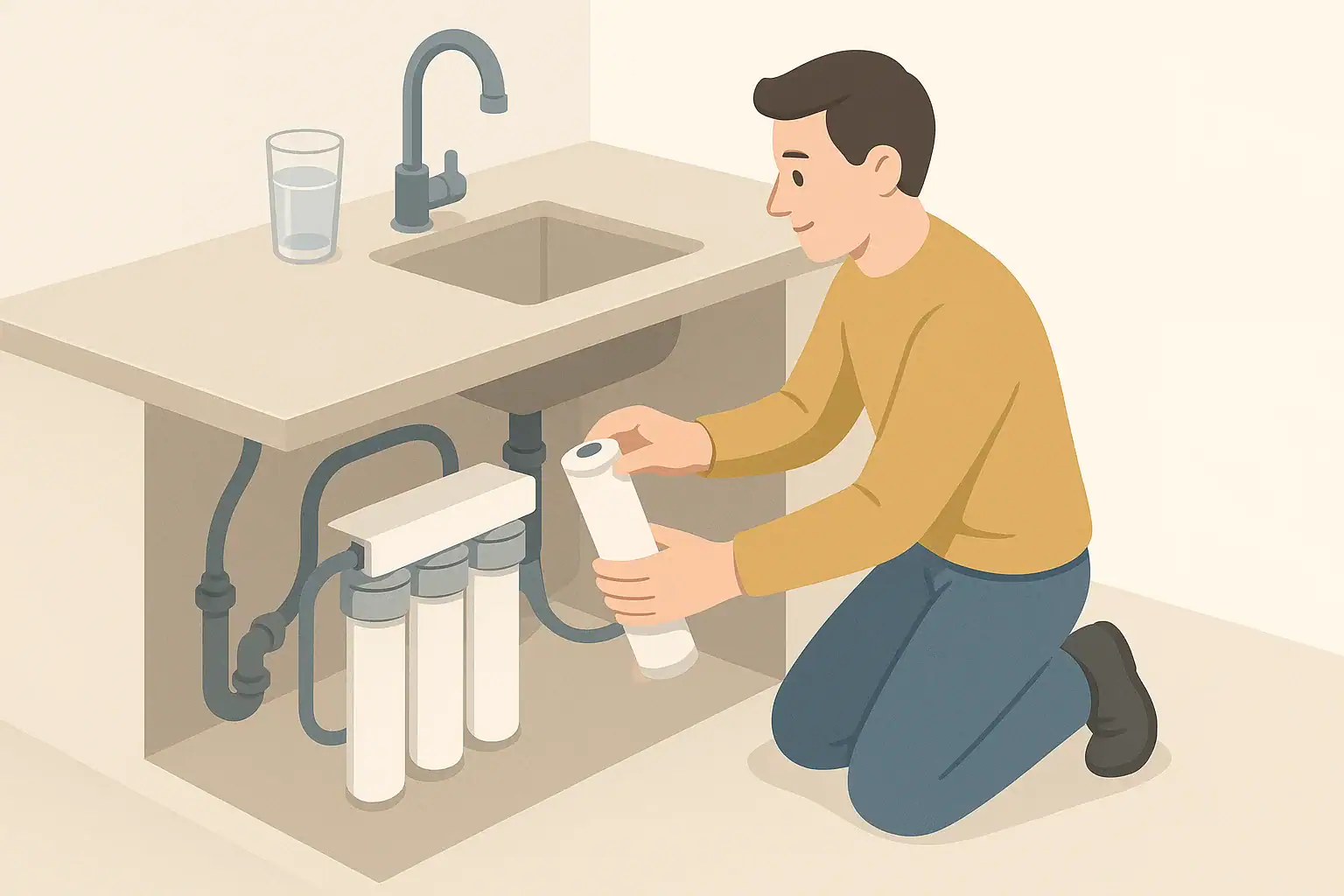
Why Arsenic in Drinking Water Needs Special Attention
\nArsenic is a naturally occurring element that can dissolve into groundwater from surrounding rock and soil. It can also come from certain past industrial activities. In the United States, arsenic is mainly a concern for private wells, but some small public systems can also be affected.
\nUnlike issues such as chlorine taste or hardness, arsenic is colorless, odorless, and tasteless at levels typically found in drinking water. You cannot detect it by looking at, smelling, or tasting your water. That is why testing and careful selection of treatment methods are important if arsenic has been found or is suspected.
\nArsenic filtration is more specialized than basic sediment or carbon filtration. It usually involves processes such as reverse osmosis, adsorption media, or ion exchange. Each option has strengths and limitations, and it is common to combine more than one type of treatment for reliable performance.
\n\nStep One: Test and Understand the Arsenic in Your Water
\nBefore choosing any arsenic filter, you need data from a recent water test. For wells, a certified laboratory test for arsenic is the most reliable option. Some public water systems already monitor arsenic and publish results in consumer confidence reports, but individual homes on private wells are generally responsible for their own testing.
\nKnow the Concentration
\nThe most useful information from the test report is the arsenic concentration, usually listed in micrograms per liter (µg/L) or parts per billion (ppb). When you compare treatment options, many will describe their performance as a percentage reduction, or as effective up to a general range of starting concentrations.
\nFilter sizing, media life, and treatment design depend heavily on how much arsenic is present. Higher arsenic levels usually require more robust systems, more frequent media replacement, or treatment at the whole-house level instead of a single faucet.
\nArsenic Species: Arsenic III vs Arsenic V
\nArsenic in water commonly appears in two main forms (species):
\n- \n
- Arsenic III (arsenite) – often harder to remove and less effectively captured by many standard media. \n
- Arsenic V (arsenate) – typically easier to remove with common arsenic specialty media and reverse osmosis. \n
Some filters work best on arsenic V. If testing or local knowledge indicates mainly arsenic III, additional pretreatment (such as oxidation) may be recommended to convert arsenic III to arsenic V before the main treatment stage.
\nOther Water Quality Factors That Matter
\nArsenic treatment does not happen in isolation. Other characteristics of your water can affect performance and media life, such as:
\n- \n
- pH (acidity or alkalinity) \n
- Iron and manganese levels \n
- Sediment and turbidity \n
- Competing ions such as sulfate, phosphate, or silica \n
- Hardness minerals that may cause scale \n
Many arsenic filters work best when sediment is removed first and when iron and manganese are controlled. In some cases, extra pretreatment is needed to protect arsenic media from fouling or clogging.
\n\nExample values for illustration.
\n| Checklist item | \nWhy it matters | \nExample consideration | \n
|---|---|---|
| Recent lab test for arsenic | \nConfirms if treatment is needed and how intensive it should be | \nArsenic measured at an example 15 ppb | \n
| Arsenic species (III vs V) | \nDetermines whether oxidation or special media are needed | \nWater reported mostly as arsenic V | \n
| Point-of-use vs whole-house need | \nImpacts system size, cost, and plumbing scope | \nOnly drinking and cooking tap treated at kitchen sink | \n
| Existing issues like iron or sediment | \nCan clog or foul arsenic media and shorten life | \nInstall sediment prefilter before arsenic unit | \n
| Household water use patterns | \nAffects flow rate, filter capacity, and cartridge change intervals | \nTwo occupants, typical use for drinking and cooking | \n
| Maintenance comfort level | \nSome systems are simpler to maintain than others | \nPreference for cartridge changes over backwashing tanks | \n
\n
Main Treatment Options for Arsenic Reduction
\nSeveral treatment technologies can significantly reduce arsenic levels in household water. The best choice depends on your test results, plumbing layout, and maintenance preferences.
\nReverse Osmosis (RO)
\nReverse osmosis is a membrane process commonly installed at a single tap, such as under the kitchen sink. It works by pushing water through a semi-permeable membrane that rejects many dissolved substances, including arsenic.
\nCommon characteristics of RO for arsenic:
\n- \n
- Often used as a point-of-use solution (drinking and cooking water). \n
- Typically paired with prefilters (sediment and carbon) and sometimes a postfilter. \n
- Can reduce a wide range of other dissolved substances along with arsenic. \n
- Generates a waste stream (concentrate) that goes to the drain. \n
Performance can vary based on membrane type, water temperature, pressure, and prefiltration. Systems are often rated in gallons per day and may have storage tanks or be tankless. If arsenic is present mostly as arsenic III, some RO systems may benefit from upstream oxidation or specialized pre-treatment.
\nAdsorptive Media (Iron or Aluminum Based)
\nAdsorptive media systems use specially formulated granules or cartridges that bind arsenic to their surface. These media are commonly based on iron or aluminum compounds and are designed specifically for arsenic reduction.
\nKey points about adsorptive media:
\n- \n
- Can be configured as point-of-use or point-of-entry (whole-house) systems. \n
- Capacity is usually specified in terms of total water volume treated before media replacement. \n
- Performance is influenced by pH, competing ions, and the arsenic species. \n
- Spent media must be replaced and disposed of according to local guidance. \n
These systems often work best when pH is in a certain range and when iron, manganese, and sediment are controlled. Some are designed to target both arsenic III and V, while others primarily address arsenic V.
\nIon Exchange
\nIon exchange systems, sometimes similar in appearance to water softeners, can be configured to remove arsenic by exchanging arsenic ions with other ions on a charged resin. This approach is usually more common at the whole-house level or for small public systems rather than single-faucet residential units.
\nMain considerations for ion exchange:
\n- \n
- Requires regeneration with specific solutions or periodic resin replacement, depending on design. \n
- Competing ions (such as sulfate or nitrate) can reduce capacity for arsenic. \n
- System sizing must match household flow rates and water chemistry. \n
Oxidation and Filtration Combinations
\nBecause arsenic III is harder to remove, some treatment strategies first oxidize arsenic III to arsenic V using oxidants such as chlorine or other oxidizing agents, followed by filtration through media that preferentially removes arsenic V. This is often implemented as part of a more comprehensive treatment train that may also handle iron, manganese, and disinfection.
\nThese multi-stage approaches are more complex to design and maintain, and they are more common for higher arsenic levels or for whole-house treatment.
\n\nHow to Read Arsenic Filter Claims and Certifications
\nProduct labels and marketing language for arsenic treatment can be confusing. Understanding how to interpret claims can help you choose more confidently and avoid unrealistic expectations.
\nGeneral Performance Claims
\nArsenic filters typically describe performance using statements such as:
\n- \n
- “Reduces arsenic” with or without specifying arsenic III or V \n
- “Up to” a certain percentage reduction in controlled testing \n
- “Effective for” a certain total volume of water or number of gallons \n
Look for clear information about which arsenic species were tested, what starting concentration was used in testing, and under what water conditions. Tests done at relatively low starting concentrations or under ideal conditions may not directly match performance in your home.
\nStandards and Independent Testing
\nSome products reference independent testing or standards relevant to arsenic reduction. When reviewing these references, consider:
\n- \n
- Whether testing was done by an accredited third-party laboratory. \n
- Whether the test conditions (arsenic form, concentration, pH, and other water parameters) are reasonably similar to your water. \n
- Whether performance was verified across the full rated capacity of the system. \n
Certifications and test reports do not guarantee performance in every situation, but they can provide additional confidence that the product was evaluated under structured conditions.
\nCapacity, Flow Rate, and Pressure
\nArsenic filters are often rated for:
\n- \n
- Capacity – the approximate volume of water that can be treated before filter replacement (for example, several hundred to several thousand gallons). \n
- Flow rate – maximum gallons per minute or per day the unit is intended to handle. \n
- Minimum pressure – the inlet water pressure needed for proper operation, particularly for RO systems. \n
Running a system at higher flow than it is rated for, or beyond its rated capacity, can reduce arsenic reduction effectiveness. Matching filter specifications to your actual water use patterns is an important part of system design.
\n\nPoint-of-Use vs Whole-House Arsenic Treatment
\nDeciding between treating only one tap or the entire home is a key planning step. Each approach has different cost, complexity, and maintenance implications.
\nPoint-of-Use (POU) Systems
\nPoint-of-use arsenic systems are installed at a specific location, usually:
\n- \n
- Under the kitchen sink with a dedicated drinking water faucet. \n
- On or near a countertop as a small treatment unit. \n
Advantages of POU systems include:
\n- \n
- Targeted treatment for water used for drinking and cooking. \n
- Smaller systems with lower initial cost than many whole-house setups. \n
- Often easier to install in apartments or rental properties, subject to local rules. \n
Limitations of POU systems:
\n- \n
- They do not treat water used in showers, bathtubs, or other taps. \n
- Each treated tap may require its own system. \n
- Flow is often lower than regular faucet flow because of treatment restrictions. \n
Point-of-Entry (POE) or Whole-House Systems
\nWhole-house arsenic treatment systems are typically installed where water enters the building so that all taps, appliances, and fixtures receive treated water.
\nAdvantages of POE systems:
\n- \n
- One central system treats water throughout the home. \n
- Useful when residents want consistent water quality at every tap. \n
- Can be integrated with other whole-house filtration needs, such as iron removal or softening. \n
Limitations of POE systems:
\n- \n
- Larger and usually more expensive than POU systems. \n
- Must be sized carefully for whole-house flow rates. \n
- Installation may require more plumbing changes, which should follow codes and safety practices. \n
In many homes, a combination is used: a whole-house system for general improvements such as sediment and iron control, plus a dedicated POU arsenic treatment system for drinking and cooking water.
\n\nMaintenance, Monitoring, and Retesting
\nArsenic treatment is not “set and forget.” Long-term effectiveness depends on proper maintenance and periodic water testing.
\nFilter and Media Replacement
\nEvery arsenic treatment technology has components that wear out or become exhausted over time:
\n- \n
- RO systems – sediment and carbon prefilters, RO membrane, and postfilters all have specific replacement intervals. \n
- Adsorptive media – media cartridges or tanks have a rated capacity, after which arsenic reduction declines. \n
- Ion exchange systems – resins may require regeneration or periodic replacement. \n
Manufacturers often provide example time or volume guidelines (for instance, every 6–12 months for certain cartridges, or after a certain number of gallons). Actual replacement timing can vary due to water quality, arsenic concentration, and household use.
\nRoutine Checks and Basic Observations
\nWhile arsenic itself is not visible, you can still monitor your system using practical cues:
\n- \n
- Track filter change dates and estimated gallons used. \n
- Listen and look for changes such as unusual sounds, leaks, or pressure drops. \n
- Replace prefilters regularly to protect the main arsenic treatment stage. \n
- Follow any sanitization or cleaning steps recommended for housings and storage tanks. \n
For any system that generates wastewater (such as RO), be aware of drain connections and make sure they remain secure and in good condition. Always avoid altering or bypassing safety features built into the treatment unit.
\nPeriodic Retesting for Arsenic
\nBecause filter and media performance changes over time, periodic arsenic testing of treated water is an important confirmation step. The appropriate retesting frequency depends on your arsenic level, system type, and risk tolerance, but many homeowners choose to test annually or after major system changes.
\nWhen retesting:
\n- \n
- Collect samples according to the laboratory’s instructions. \n
- Test both raw (untreated) and treated water if possible, so you can see actual reduction. \n
- Use results to fine-tune replacement intervals and, if needed, to reconsider system design. \n
Example values for illustration.
\n| Component | \nTypical replacement basis | \nExample interval | \n
|---|---|---|
| Sediment prefilter | \nTime or pressure drop, whichever comes first | \nEvery 3–6 months | \n
| Carbon prefilter | \nTime or rated gallons used | \nEvery 6–12 months | \n
| RO membrane | \nPerformance decline or maximum service life | \nEvery 2–5 years | \n
| Arsenic adsorptive media | \nRated capacity or arsenic breakthrough in tests | \nEvery 1–3 years | \n
| Ion exchange resin | \nRegeneration frequency or resin exhaustion | \nRegenerate as specified, replace after several years | \n
| Postfilter polishing cartridge | \nTime-based or taste/odor changes | \nEvery 6–12 months | \n
| Arsenic lab retest | \nTime-based check on treated water quality | \nAbout once per year | \n
\n
Related guides:\nNitrates in Well Water: What Filtration Works Best? •\nLead in Tap Water: Practical Steps Before Buying a Filter •\nPFAS Removal Options: RO vs Carbon vs Whole House
\n\nPutting Arsenic Filtration Basics into Practice
\nSelecting an arsenic filtration solution is a step-by-step process: confirm the problem with testing, understand your water’s chemistry, compare treatment technologies, and match system sizing and maintenance to your household’s needs. With realistic expectations and consistent monitoring, arsenic reduction can be integrated into a broader water treatment plan that also addresses everyday concerns such as taste, odor, and sediment.
\nFocusing on the fundamentals—accurate testing, appropriate technology, proper installation within plumbing codes, and regular maintenance—helps ensure that your arsenic filtration system continues to perform as intended over the long term.
\n\nFrequently asked questions
\nHow often should I test my water for arsenic?
\nTest raw well water at least once a year and test treated water after installation or major changes. Follow the laboratory’s sampling instructions and, when possible, submit both untreated and treated samples to confirm system performance.
\nCan common carbon or sediment filters remove arsenic?
\nStandard carbon and sediment filters alone generally do not remove arsenic reliably. Effective household options discussed above include reverse osmosis, adsorptive media, ion exchange, or oxidation followed by filtration, depending on arsenic form and your water chemistry.
\nShould I install a point-of-use system or a whole-house system?
\nIf you only need drinking and cooking water treated, a point-of-use system is often sufficient and more economical. Choose a whole-house system when you want all taps treated or when other whole-house issues (for example, iron or sediment) must be addressed.
\nWhat routine maintenance keeps arsenic treatment working well?
\nReplace prefilters and cartridges on the recommended schedule, monitor for pressure drops or leaks, replace adsorptive media or resin when capacity is reached, and retest treated water periodically to verify continued performance.
Recommended next:
- NSF/ANSI standards explained (42/53/401/58)
- Clear trade-offs: pitcher vs faucet vs under-sink vs RO
- Maintenance planning: cost per gallon and replacement cadence